Simple Cleaning
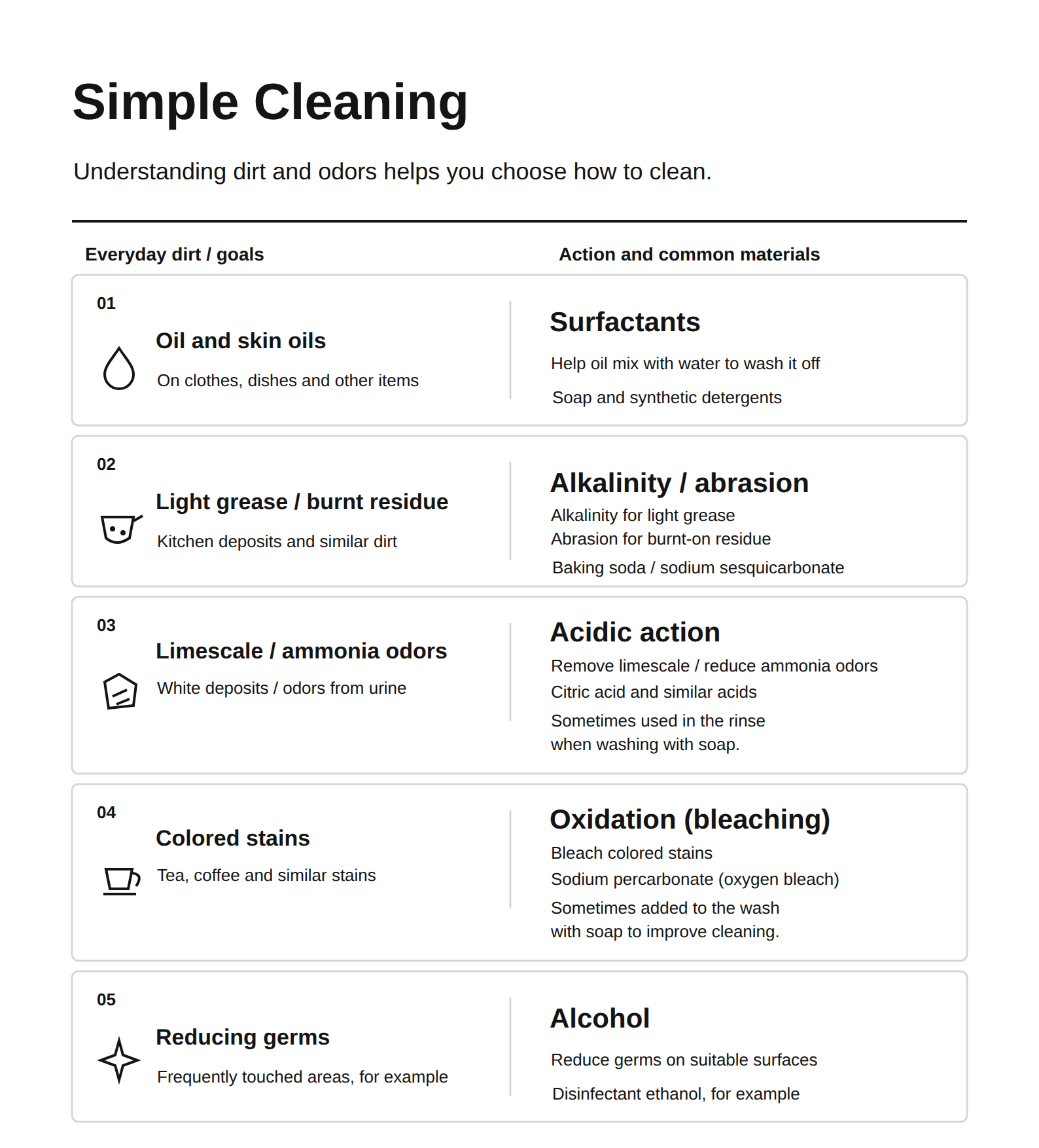
Understanding what causes dirt and odors helps you choose how to clean.
Grease in the kitchen, limescale on a faucet, stains on clothing: all are forms of dirt, but they respond to different cleaning methods. Here, “simple cleaning” means choosing a method to suit both the dirt and the item being cleaned. These everyday examples introduce five ways to approach cleaning and laundry.
Everyday dirt and cleaning goals: five types of action
1. Oil and skin oils | Surfactants
Both soap and synthetic detergents use surfactants to help oil mix with water. Their water-attracting and oil-attracting parts help wash oily dirt off clothing, dishes and other items. ACS: how soap and detergents work (English)
2. Light grease and burnt-on residue | Alkalinity and abrasion
Baking soda and sodium sesquicarbonate are used for their alkaline action on light grease. Scrubbing with baking soda powder also provides abrasion to remove burnt-on residue. Sodium sesquicarbonate dissolves readily in water and is not suited to scrubbing away hardened, burnt-on deposits. LEC: sodium sesquicarbonate uses and limitations (Japanese)
However, baking soda powder can scratch some materials. Shabondama Soap advises against using it on marble, aluminum, lacquerware and certain other materials. The suitable method depends on the residue and the material, so check the instructions for the item being cleaned too. Shabondama Soap: baking soda uses and restrictions (Japanese)
3. Limescale and ammonia odors | Acidic action
Acids such as citric acid are used on white limescale around faucets and on ammonia odors from urine. Different sources of odor need different approaches, so first check what is causing the smell. LEC: citric acid uses (Japanese)
Citric acid is sometimes used in the rinse stage when washing with soap. Shabondama Soap's Japanese guidance describes using it in the final rinse. This is not an instruction to mix it with soap or oxygen bleach in the wash. Citric acid itself does not work in the same way as fabric softener. Shabondama Soap: laundry FAQ (Japanese); Shabondama Soap: differences from fabric softener (Japanese)
Some washing machines do not allow its use. Panasonic's Japanese guidance advises against using citric acid for washing clothes. Laundry and appliance maintenance have different conditions, so give priority to the instructions for your particular machine. Panasonic: washing machine restrictions (Japanese)
4. Colored stains | Oxidation (bleaching)
Sodium percarbonate is an ingredient in oxygen bleach. Some products use oxidation to tackle colored stains such as tea and coffee. There are materials on which these products must not be used, including wool, silk and some metals. Check the product's restrictions. Shabondama Soap: oxygen bleach uses and restrictions (Japanese)
When washing with soap, oxygen bleach is sometimes added during the wash to improve cleaning. Check the conditions for the product, clothing and machine you use. Shabondama Soap: laundry FAQ (Japanese)
Sodium percarbonate is a different substance from the carbonate used to assist cleaning. Do not seal the dissolved solution in a container. It releases oxygen and may cause the container to burst. Shabondama Soap: why not to store it sealed (Japanese)
5. Reducing germs | Alcohol
Removing dirt and reducing germs are different goals. Remove dirt first, then consider whether disinfection is needed for the situation. CDC: cleaning and disinfection basics (English)
Disinfectant ethanol is used to reduce germs on suitable surfaces. It is less effective against some microorganisms and can damage materials such as some plastics. Keep it away from flames and other ignition sources, and follow the product label for its intended use, concentration and method of use. Kenei Pharmaceutical: alcohol action and precautions (Japanese)
Key points
- Check the product label and the instructions for the item and appliance. Follow the stated amounts, material restrictions and precautions such as ventilation and gloves. Products with the same ingredient name do not necessarily have the same uses or conditions.
- Baking soda powder can scratch surfaces. Do not use baking soda or citric acid on marble. Check the material to avoid scratches or other damage. Kenei Pharmaceutical: materials unsuitable for citric acid (Japanese)
- Use chlorine-based cleaners on their own. Do not mix them with acids such as citric acid, or with alcohol. Cleaner may remain in drains and other places, so avoid using other cleaning agents immediately afterward. National Consumer Affairs Center of Japan: chlorine-based household cleaners (Japanese)
- Keep alcohol away from ignition sources. Follow the product label and ventilate the area.
- Do not seal a solution of sodium percarbonate in a container. Keep the powder in its original product container; do not transfer it to another airtight container. Shabondama Soap: storage precautions (Japanese)
Next steps
- Look at the cleaners you already use Check their ingredients and intended uses to see how they work.
- Compare the dirt and the material Think about which method suits both the dirt and the item being cleaned.
- Apply this to cleaning and laundry Check product labels and appliance instructions, then try methods that suit your daily life.